Journal Article2023
The minds of machines: Children’s beliefs about the experiences, thoughts, and morals of familiar interactive technologies
Flanagan, T., Wong, G., & Kushnir, T.
Developmental Psychology
Research
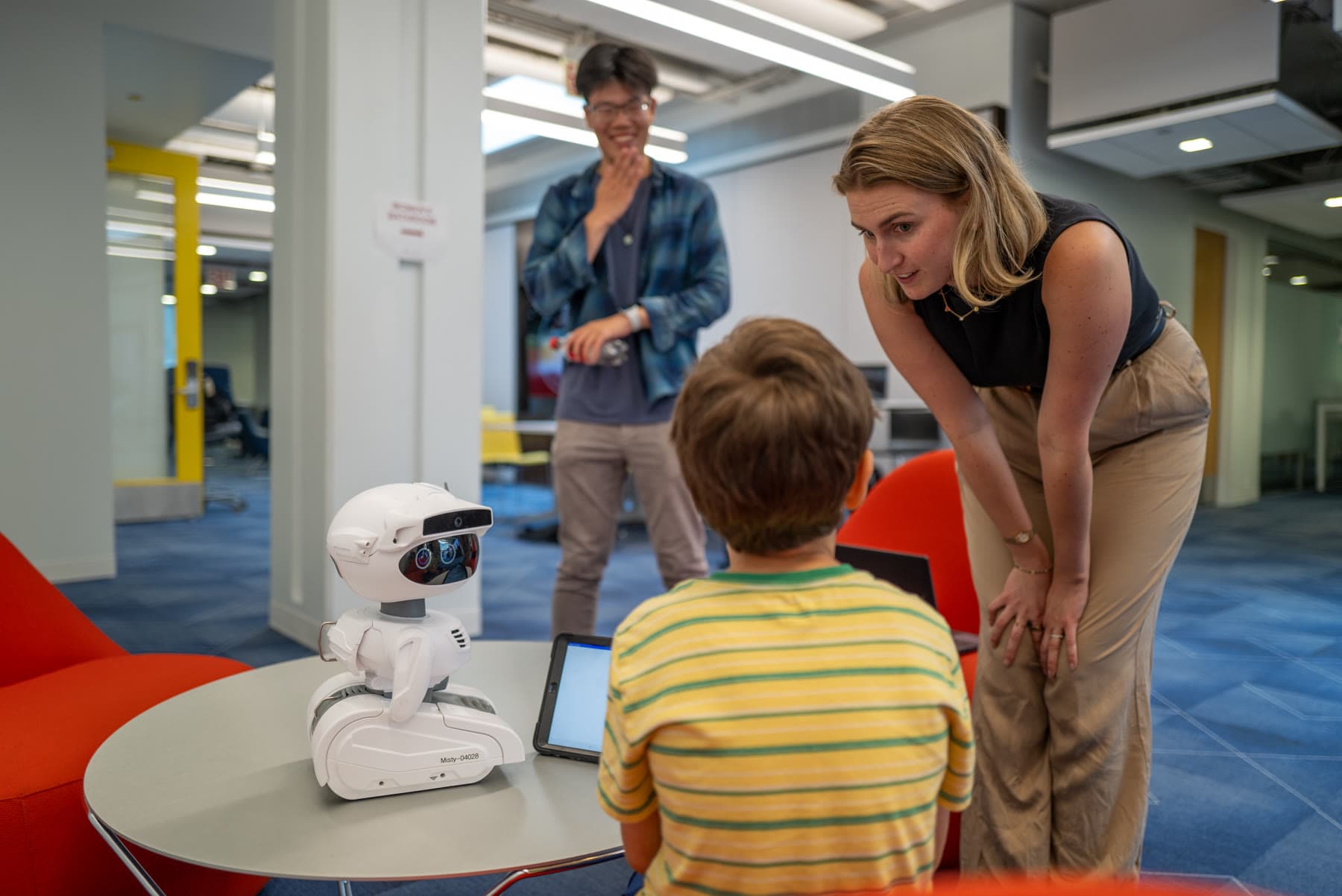
We are surrounded by interactive technologies that look, move, and act like agents. My work looks at how we think of and engage with these technologies as agents.
01
What kind of thing do we take a robot to be?
I study the beliefs children and adults hold about what machines can feel, know, choose, and deserve. Those ideas are more structured than a simple verdict about whether a robot is alive, and they change with age, experience, and the kind of machine someone encounters.
Flanagan, T., Wong, G., & Kushnir, T.
Developmental Psychology
Flanagan, T., Rottman, J., & Howard, L.
Cognitive Science, 45(10), e13043
Georgiou, N., Flanagan, T., Scassellati, B., & Kushnir, T.
Proceedings of the 2025 ACM/IEEE International Conference on Human-Robot Interaction (HRI ’25)
Flanagan, T., & Kushnir, T.
HUMANA.MENTE Journal of Philosophical Studies, 15(42), 179–204
Flanagan, T., Rottman, J., & Howard, L.
Proceedings of the 41st Annual Conference of the Cognitive Science Society
02
How do we come to trust and connect with robots?
I also study what happens once an interaction is underway: whether people trust a robot, feel connected to it, or want to keep engaging. Children do not simply scale down the adult response; their trust and connection follow a developmental path of their own.
Flanagan, T., Georgiou, N., Scassellati, B., & Kushnir, T.
Cognition
Flanagan, T., Zhang, J., Bian, L., & Sebo, S.
Proceedings of the 2026 ACM/IEEE International Conference on Human-Robot Interaction (HRI ’26)
Flanagan, T., & Kushnir, T.
In D. Cameron & A. Perry (Eds.), AI Empathy
03
Social cognitive development
How do we come to understand other minds at all?
Not all of this work is about technology. I also study how children reason about explanation, evidence, and other minds, which is the foundation for the questions I ask about machines.
Selected papers
But why?: Children’s belief in the necessity of explanations
Flanagan, T., Vesga, A., Kushnir, T., & Nichols, S.
Journal of Experimental Child Psychology
Is it personal or is it social? The interaction of knowledge domain and statistical evidence in U.S. and Chinese preschoolers’ social generalizations
Flanagan, T., Zhao, X., Xu, F., & Kushnir, T.
Journal of Experimental Psychology: General
Individual differences in counterfactual fluency predict judgments of free will
Flanagan, T., & Kushnir, T.
Proceedings of the 41st Annual Conference of the Cognitive Science Society